Pentiment

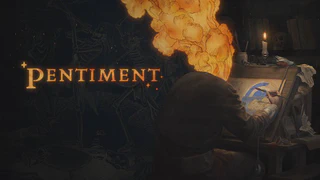 Pentiment
For the first time, Pentiment made the word “history” feel alive with emotion. She is the ship of Theseus, endlessly taken apart and rebuilt, but more passionate; she is Jesus, endlessly dying and rising again, but more bewildered. She’s whirling in rags, she’s vast and she’s sad.
Pentiment feels more like a work of literature than a game. As a game, its investigation system is underdeveloped: gathering clues feels mechanical and arbitrary, the deductions you can make are constrained, and many leads cannot be pursued further. But the world it portrays gave me a feeling unlike anything else. You are a painter in a small Bavarian town in the early sixteenth century. Martin Luther, the printing press, the German Peasants’ War, the Renaissance—these cold phrases from textbooks become forces that actually shape the lives of those around you. Unlike films or novels that offer only a vague picture of the past and project modern values onto it, Pentiment creates a medieval town that feels truly alive.
The game’s mysteries form a labyrinth spanning a thousand years. In this labyrinth called time, historical forces shape people, while their perspectives and beliefs, in turn, shape the telling of history. When the mystery finally unravels, the meaning of the word “pentiment” becomes tangible: on the canvas called Tassing, brushstrokes are continually erased and painted anew. I saw the ancestors of Tassing sitting around a fire, worshipping their gods. I saw Romans mining ore and building baths. I saw monks working and praying in the newly built abbey. New layers of paint try to cover those earlier traces, yet the traces keep showing through—though no longer quite as they once were.
As I played, I found myself almost envying the people of Tassing. They live on layers of history, among Roman ruins, under the protection of saints, surrounded by ancient legends. It is as though they live alongside their ancestors. Where I live, there’s nothing. I have no idea what the Native Americans or the Germanic invaders left behind on this land. Perhaps just road construction and long winters. Thankfully, technology has given me books, games, and films to keep me company. There may be no Roman ruins next to my house, but there are some inside the little glowing box in front of me. That’s pretty good, too.
The characters live at a moment when an old world is giving way to a new one, across a boundary historians would draw between the Middle Ages and the modern era. For better and for worse, they were born into this age of change. The prosperity of the past goes up in flames, while the future follows a rough road toward something brighter.
And here I am, living in the age of AI. A few years ago, it was the pandemic; a few years before that, China’s economic boom. I don’t know whether future historians will also draw a dividing line through these years. I don’t know where time’s endlessly swirling skirt will fling me. But I hope I can face it with the same openness as Brother Piero:
“Time passes for us all, things change, the future will write over the present. You need not fear it, any of it, so long as you remain true to yourself and God.”
